
While geopolitical developments dominated the headlines in Q1 2026, RCF was thinking one level down. How did US action against the former Venezuela president and more recently Iran specifically impact both existing and potential new investments in the Funds? It was helpful to have some forewarning early in the quarter, before the larger conflict started. Senior RCF attendees at the Saudi Future Minerals Forum from 13-15 Jan 2026 heard about the US evacuating nonmilitary personnel from Qatar along with open conference discussions about the imminent start of hostilities with Iran, six weeks before actual hostilities commenced.
Given the potential and subsequent realized disruptions, metal stocks (above-ground inventory), trade flows and supply scarcity have preoccupied RCF commodity strategy focus throughout the quarter. To illustrate why these three factors are interesting, let’s focus on how the investment environment has differentially impacted the gold, silver, copper and lithium markets.
Digging into the data, these four metals travelled very different price pathways through the first 90 days of 2026. Firstly, the graph below shows that all four metals have held their value through the quarter; none suffered a negative price return. Secondly, silver and lithium were incredibly volatile (60% up in January alone), backed by scarcity, along with stock and flow movements. Finally at quarter end, copper finished essentially flat, silver was up 5%, gold was up 10% and lithium had risen 55%.
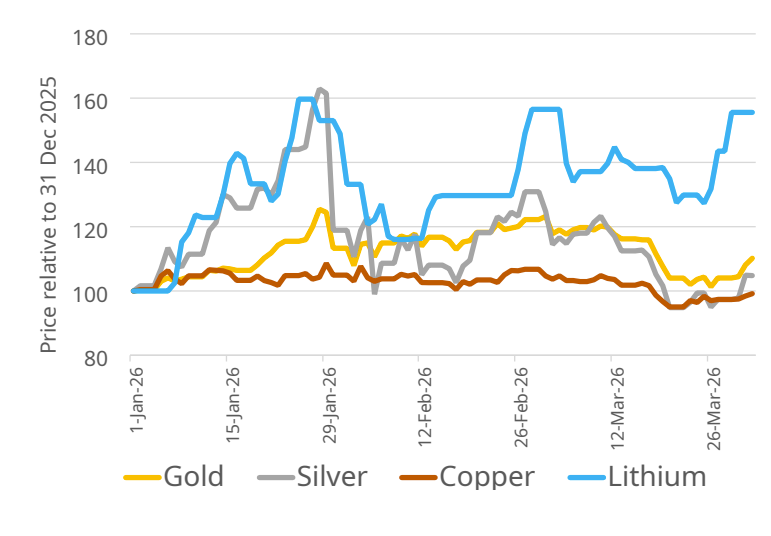
Source: Bloomberg & Fastmarkets data, RCF Analysis, as of 1 April 2026
Recognizing each market is different, the following table provides RCF commodity strategy data and commentary related to industrial use (vs monetary investment), along with the condition of metal stock, demand flows and current / future physical scarcity in the quarter:
| Industrial Use | Stocks | Flows (demand) | Scarcity | |
| Gold | 7% | Plentiful | Rising | Demand dependant |
| Silver | 60% | Plentiful | Rising | Cumulative deficits |
| Copper | 98% | Rising | Rising | Next decade |
| Lithium | 100% | Depleted | Rising | Next few years |
Starting with Gold, only 7% of gold production makes its way into industrial use, primarily circuit boards and advanced electrics, whereas 93% of all gold demand is jewellery and/or monetary investment. RCF notes that above-ground gold stocks are plentiful due to historical mining and generational gold storage in the forms of jewelry, bars and coins. All existing gold is accessible, at a price. From a demand flow perspective, gold demand was up 2% volumetrically and 74% in value (USD terms) in Q1 2026 (YoY)1. Beneath the supply & demand surface, the gold market saw outflows from ETFs (profit taking), but a steep rise in physical bar and coin demand. Finally, gold remains geologically scarce and inherently valuable, driving its ongoing investment case. All future in-ground gold ounces will be mined at a relatively higher cost than prior historical production, delivering on gold’s inflation hedge characteristics, as a genuine real asset.
Silver is a byproduct metal, both geologically AND in terms of the two distinct markets it serves. 60% of silver demand is industrial use (electronics, photovoltaic, alloys, solders and photography), with the balance of silver demand going to jewelry, silverware and bar & coin investment. Silver demand continues to rise despite multi-year supply deficits (since 2021 physically and since 2019 if ETF flows are added). From a physical scarcity standpoint, these cumulative deficits were further exacerbated by a Jan 2026 physical metal squeeze, where there wasn’t enough silver to meet physical futures expiration. This was known in the market and bid throughout Jan 2026, before being violently unwound at expiry by financial market players. The interplay between financial and physical precious metals trading is not RCF core business, but we do follow it from a commodity strategy standpoint.
Copper fundamentals remain robust; however, the metal experienced a dull quarter pricewise, relative to gold, silver and lithium. This is partly due to ample above ground supply, along with healthy recycling flows. That said, copper miners are enjoying robust demand and decent pricing for mine supply; the slack in the copper market is further downstream in refined copper metal. Specifically, copper mine supply was only up 1% last year, but refined metal supply was up 4.5% and refined metal demand was up 2.8% for 20252. Recycling flows and strong smelter output is temporary, eventually new mines need to be built. RCF is anticipating this, but we are not alone. With 98% industrial use, most copper porphyry projects costing multi-billions and taking 3-5 years to construct from a final investment decision, new copper mine investments remain the ‘supertankers’ within the metals & mining investment world. And the seeds of the next upcycle are already sown.
Lithium is currently white hot, accelerating off near zero above ground stock in June 2025 to current price and demand levels. Looking forward, the lithium market is showing no signs of slack over the next few years. RCF anticipated this market dynamic, in each of the prior lithium market upcycles (2020 and 2025). While there is some elasticity in supply, the fundamental lithium investment case is underpinned by a rapidly growing energy storage industry (EVs + stationary storage). Demand growth will outpace mine supply over the next few years, until new mine investment catches up and overtakes near-term demand. The cyclicality and volatility in lithium are predictable and lithium continues to provide countercyclical investment performance for current RCF investors.
In closing, RCF has chosen to focus on these four metal markets because they are material commodity market exposures for past and current funds. RCF’s more recent funds have held multiple gold, copper and lithium investments supported by commodity strategy insights, with the funds benefitting from exposure to byproduct silver associated with copper mining investments. Byproduct silver certainly helps overall investment attractiveness, considering high demand by royalty and streaming companies for silver offtake in the current market.
Looking forward, all four markets continue to look healthy heading into Q2 2026, despite energy markets taking centre stage from metals & mining during Q1, with the ongoing Iran conflict and the Straits of Hormuz closure.

Important Information
This material is provided for educational purposes only and should not be construed as research. The information presented is not a complete analysis of the commodities landscape.
Forward-looking statements are presented for illustrative purposes only and are not guarantees of future performance. Actual performance will vary due to a variety of factors, including general economic conditions. Neither RCF nor any independent third party has independently audited or verified this information.
The opinions expressed may change as subsequent conditions vary. The information and opinions contained in this material are derived from proprietary and non-proprietary sources deemed by Resource Capital Funds and/or its affiliates (together, “RCF”) to be reliable. No representation is made that this information is accurate or complete. There is no guarantee that any forecasts made will come to pass. Reliance upon information in this material is at the sole discretion of the reader.
None of the information constitutes a recommendation by RCF, or an offer to sell, or a solicitation of any offer to buy or sell any securities, product or service. The information is not intended to provide investment advice. RCF does not guarantee the suitability or potential value of any particular investment. The information contained herein may not be relied upon by you in evaluating the merits of any investment.
References to market, composite, or commodity specific indices, determined by a third party, are provided for informational purposes only. Index information was compiled from sources that RCF believes to be reliable. No representation or guarantee is made hereby with respect to the accuracy or completeness of such data. Reference to an index does not imply that a fund will achieve returns or other results similar to the index. These indices cannot be invested in directly by a fund or other investors. The market volatility, liquidity, concentrations, restrictions and other characteristics of private market investments are materially different from indices, and therefore the indices do not necessarily reflect a basis for comparison with private market investments. The performance of these indices is reported on the gross performance of the underlying assets and does not take into account any fees or expenses that may be associated with investing in those assets. Any attempt to mimic the indices will result in fees and expenses associated with investing and will reduce performance.
Past performance is not indicative of future results. Investing involves risk, including possible loss of principal.